The source: a magnetic flux rope erupts
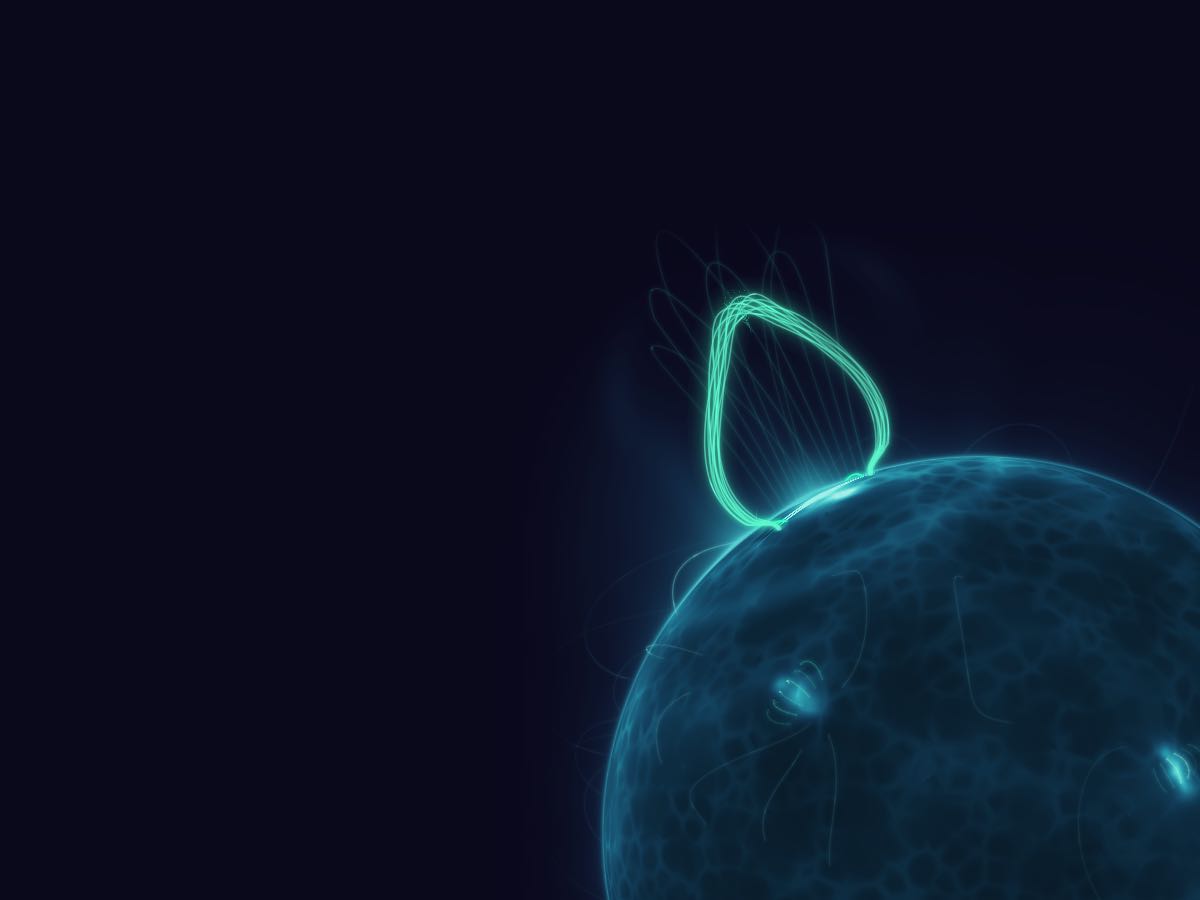
Above an active region, a twisted magnetic structure rises and then erupts. The Sun’s magnetic field can twist into a magnetic flux rope: a bundle of twisted field lines. The magnetic arches that lie over it hold it down: its “cage”. Energy builds up in it over days. When the balance breaks, the rope rises faster and faster and releases that energy within minutes to hours. If the rope breaks through its cage, it carries away a cloud of magnetised plasma, a coronal mass ejection (CME); otherwise, the eruption stays confined. This configuration before the eruption is the subject of Tahar Amari’s work published on the cover of Nature in 2014 and 2018.
The transit: a coronal mass ejection crosses space
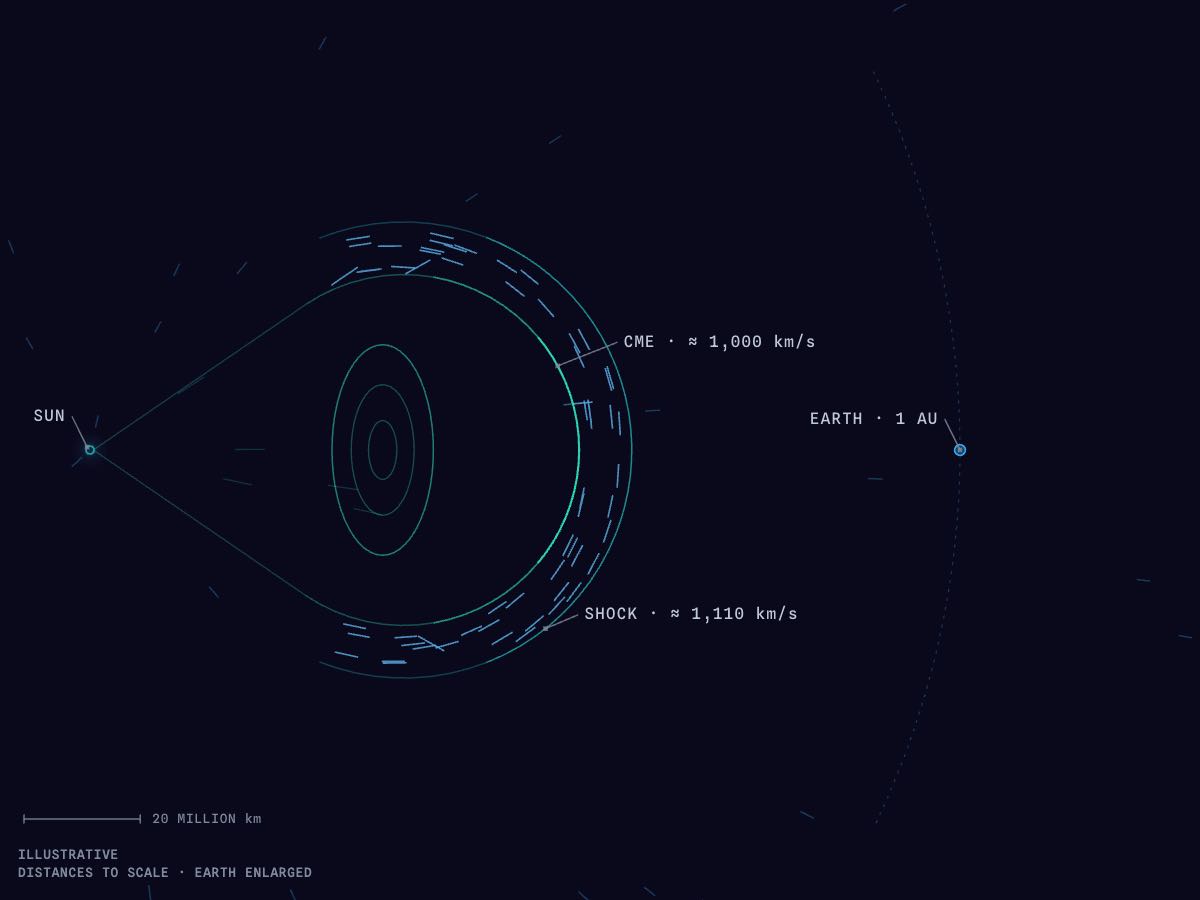
A CME typically reaches Earth in one to three days, the fastest in under 18 hours. It leaves the Sun at speeds from about 250 to nearly 3,000 km/s. A fast CME drives a shock wave ahead of it, which compresses the solar wind. Behind the shock comes the sheath, a dense and turbulent plasma, then the magnetic cloud itself. What matters on arrival is the direction of its magnetic field. When it points south, opposite to Earth’s field, the solar wind can transfer its energy into the magnetosphere. Not every CME is aimed at Earth: only those heading towards it, or grazing it, will count.
The geomagnetic storm begins: Earth’s shield is compressed
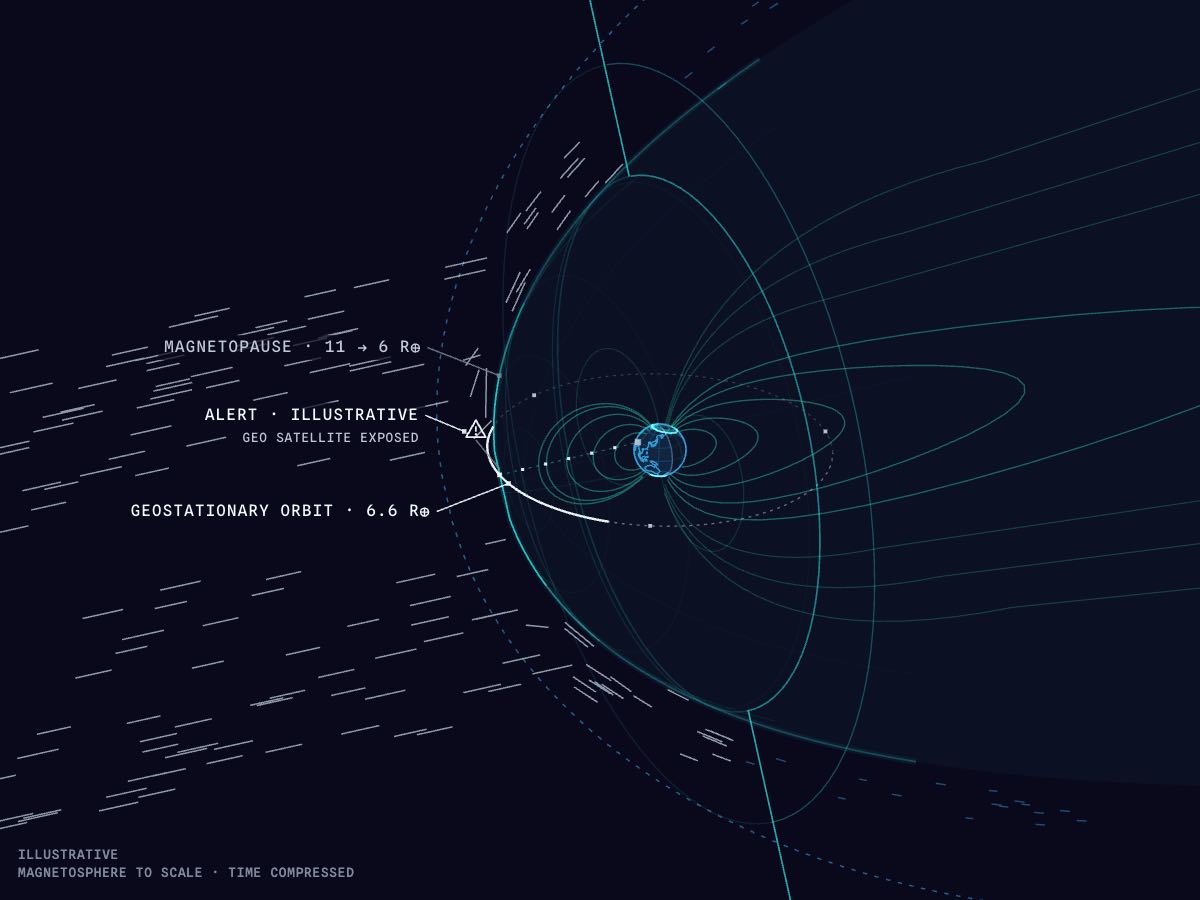
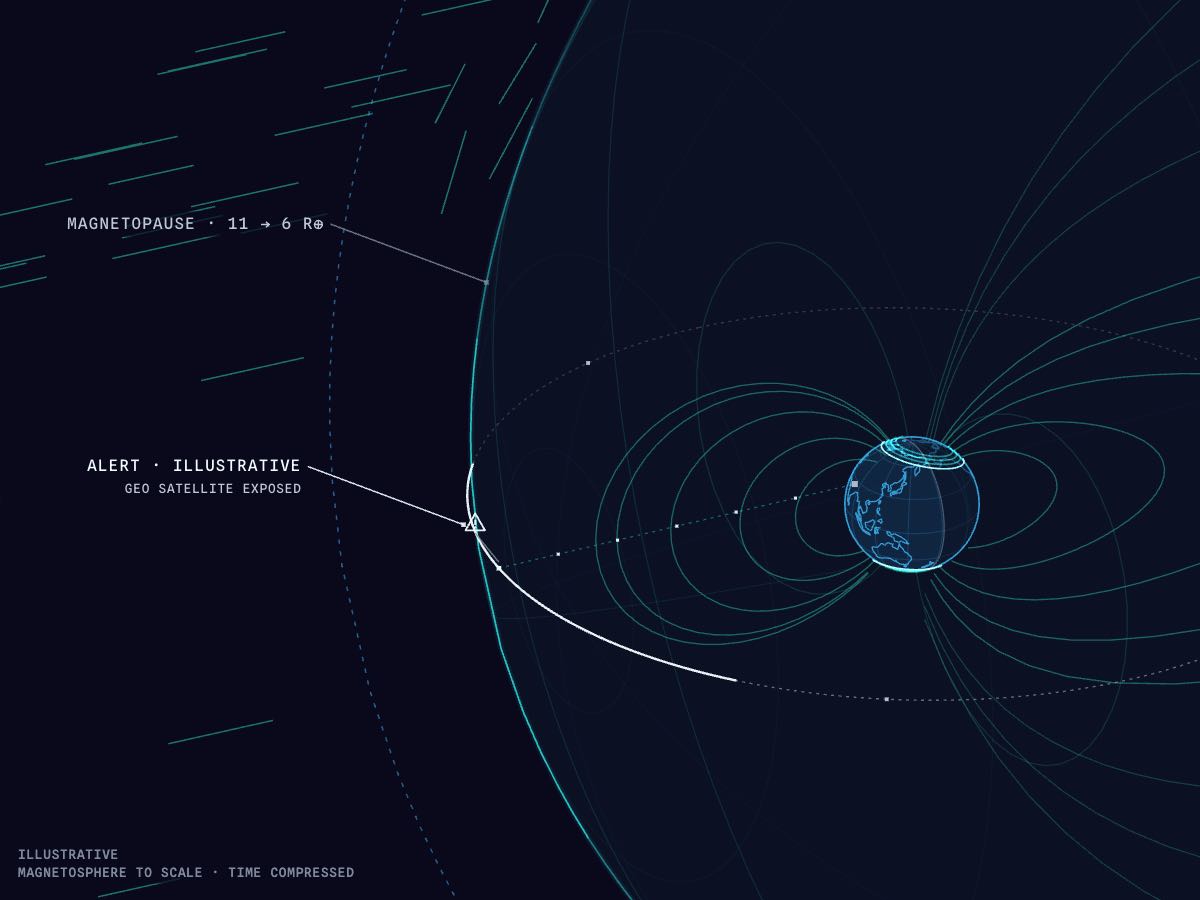
When the shock arrives, Earth’s magnetic shield is compressed on the dayside. The magnetosphere, the region ruled by Earth’s magnetic field, normally holds the solar wind back at about 11 Earth radii on the dayside. When the shock and then the dense sheath arrive, the pressure of the solar wind rises about twentyfold. In the example shown, the magnetosphere’s boundary, the magnetopause, moves in from 11 to about 6 Earth radii. It passes inside the geostationary orbit (6.6 Earth radii from Earth’s centre, or 35,786 km in altitude). This is the sudden commencement of the geomagnetic storm.
Satellites exposed to the storm
A geostationary satellite near local noon finds itself outside the shield. It then sits in the magnetosheath, the shocked solar wind plasma between the magnetopause and the bow shock. Within hours, the geomagnetic storm sets in: the auroral oval spreads towards lower latitudes, and the upper atmosphere heats up and slows down satellites in low orbit. In February 2022, a minor storm (Kp 5) raised drag enough to cost 38 of 49 newly launched Starlink satellites.
The satellites use case · The EU Space Act and natural hazards
On the ground: induced currents in power grids
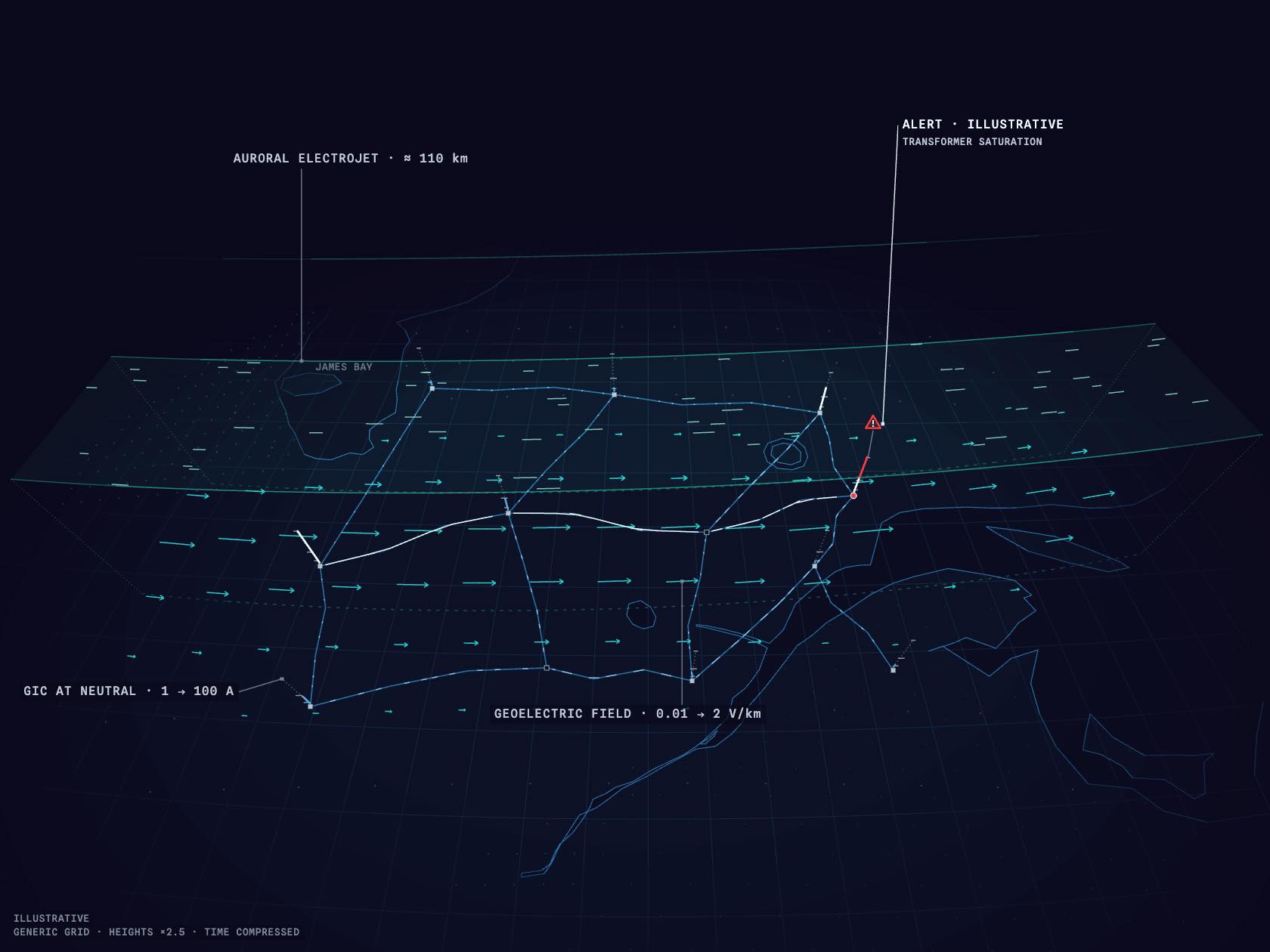
On the ground, the storm drives currents into long power lines. Under the auroral oval, strong electric currents flow at about 110 km in altitude: the auroral electrojet. When it intensifies within minutes, the magnetic field changes at the ground and induces an electric field in the subsoil. That field is all the stronger where the rock is resistive, as in the Canadian Shield. In long high-voltage lines, this field drives quasi-direct currents, geomagnetically induced currents (GIC). They enter transformers through their grounded neutral and can saturate them. On 13 March 1989, the Hydro-Québec grid collapsed in 92 seconds, leaving Québec without power for nine hours.
The energy use case
The complete chain, starting from the source
Our ambition is to cover this whole chain, from the Sun’s magnetic configuration to the impact on satellites and power grids. Each link depends on the one before, from an active region to the current in a transformer. SKEION starts from the source. MeshMHD, the magnetohydrodynamic model of the Sun developed at CPHT (CNRS / École polytechnique) under the direction of Tahar Amari, reconstructs in 3D the magnetic structures behind eruptions. We are building the chain step by step: first the physics of the source, then propagation in space, up to the impact on infrastructure.
The scientific foundation