

Regulation · Satellites
EU Space Act: where the text stands, and what it says about space weather.
The EU Space Act is a proposed European Union regulation on the safety, resilience and sustainability of space activities. The European Commission presented it on 25 June 2025. It would set common rules for space operators active in the EU market, including those established outside the Union. As of 4 October 2026, it is still under negotiation and has not been adopted.
Where the text stands
Under negotiation, not adopted.
The Council (the Member States) and the European Parliament must each adopt a position before negotiating the final text together. As of 4 October 2026, neither has done so.
European Commission proposal, COM(2025) 335.
Council: first compromise text (Danish Presidency).
Parliament: draft report of rapporteur Elena Donazzan (Industry committee, ITRE).
Council: compromise text on the whole regulation (Cyprus Presidency).
Council progress report: all Member States keep a scrutiny reservation; scope, governance and non-EU operators remain open.
The Council resumes its work under the Irish Presidency, on the 30 March text. In Parliament, the ITRE committee has not yet voted.
- Next
Parliament’s position and the Council’s general approach, then negotiations between the two (trilogues), adoption and publication in the Official Journal.
Who is concerned
Operators, inside and outside the Union.
- Operators established in the EU (satellites, launches, in-orbit services): authorisation by a national authority and entry in an EU register of space activities.
- Operators established outside the EU that provide space services or space-based data in it: registration with the EU Agency for the Space Programme (EUSPA) and a legal representative in the Union. A simpler route applies if their country’s rules are recognised as equivalent.
- What the text asks: common rules on safety (tracking, collision avoidance, debris), resilience (risk management, cybersecurity, incident reporting) and environmental sustainability. They are scaled to size and risk, and lighter for small companies, research and education.
- Not covered, as proposed: space objects used exclusively for defence or national security (Article 2), and assets launched before the rules apply.
Space weather
It does not name space weather.
None of the texts published so far names space weather, solar activity or geomagnetic storms. The closest is the resilience chapter, the most debated part of the text.
- Commission proposal: risk management based on an all-hazards approach (Article 76), crisis measures against natural disasters (Article 87) and, in Annex VII, “hardening and shielding against natural radiation” for the space segment.
- Council text of 30 March 2026: the chapter is reduced to cybersecurity rules aligned with the NIS 2 Directive. Their all-hazards approach protects network and information systems “and the physical environment of those systems” (Article 75a). The natural-disaster and radiation provisions are no longer in it.
- Parliament draft report: it would delete the chapter and extend NIS 2 to space activities.
Whether this covers solar storms is a matter of legal interpretation. Our reading, not the text’s: space weather affects what the text regulates, such as collision avoidance, through atmospheric drag.
What SKEION brings
Space weather in your risk analysis, whatever the final text.
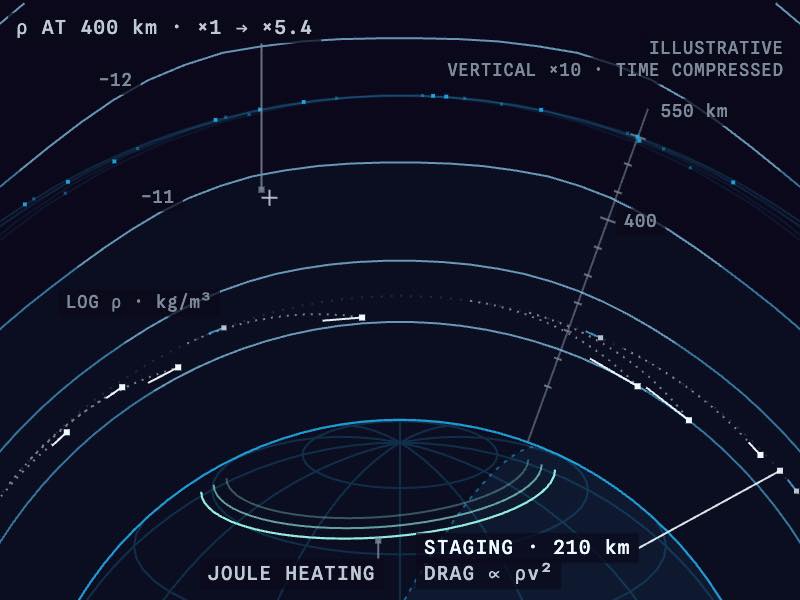
A satellite loses altitude faster than expected, or suffers an anomaly. Did space weather play a part? The operator needs to know, and to document it.
Our first deliverable, Event Replay, replays a past solar storm of your choice, adapted with you to your satellites, to support your incident analysis, your insurance claims and your reports.
SKEION’s technology comes from CNRS research on solar eruptions, published on the cover of Nature in 2014 and 2018.
SKEION provides technical input, not legal advice, certification or a compliance assessment.
Questions
Questions and answers.
What is the EU Space Act?
A proposed EU regulation on the safety, resilience and sustainability of space activities, presented by the European Commission on 25 June 2025 (COM(2025) 335) and still under negotiation. It aims at a single market for space activities.
When will it apply?
Not before it is adopted and published in the Official Journal, which had not happened as of 4 October 2026. The Commission proposed 1 January 2030; the Council’s text, 36 months after entry into force.
Who does it apply to?
Space operators established in the EU, and those established elsewhere that provide space services or space-based data in the EU. The Council’s text adds providers of space-based data when those data are their sole service or a decisive part of it.
Does it apply to defence?
As proposed, no: space objects used exclusively for defence or national security, or temporarily placed under military control, are excluded (Article 2). The Council’s text widens this exclusion, whose exact reach is still debated.
What does it say about space weather?
Nothing by name. Whether an all-hazards approach covers solar storms is a matter of legal interpretation; the proposal’s provisions on natural disasters and natural radiation are no longer in the Council’s text.
Where can I read the official text?
On EUR-Lex for the Commission’s proposal (all EU languages), on the European Parliament’s Legislative Observatory for procedure 2025/0335(COD), and in the Council’s register for its compromise texts (in English). Links below.
Sources
The official texts.
- European Commission
- Proposal for a regulation COM(2025) 335, 25 June 2025, EUR-Lex · EU Space Act page
- European Parliament
- Procedure file 2025/0335(COD), Legislative Observatory (status, draft report, opinions, amendments)
- Council of the EU
- Presidency compromise texts 16437/25 (5 December 2025) and 7806/26 (30 March 2026), progress report 8861/26 (8 May 2026), PDF
- Analyses
- Parliament draft report, as summarised by Gleiss Lutz and Hogan Lovells Cadwalader (March and May 2026)
Last checked: , in the texts themselves.
Do you operate satellites?
In a pilot project, we explore with you how our solutions can meet your specific needs and solve your problems. From your case, we adapt and improve them so they fit the way your teams work.